BestGlobalOffers Visual Book Lab

THE POWER OF HABIT

Why we do what we do — and how to change it

by Charles Duhigg · A visual and interactive guide

Instead of just reading a summary, experience the ideas. This visual journey takes you through the habit loop, the Golden Rule of habit change and keystone habits — with interactive tools you can actually use.

Explore the Experience →
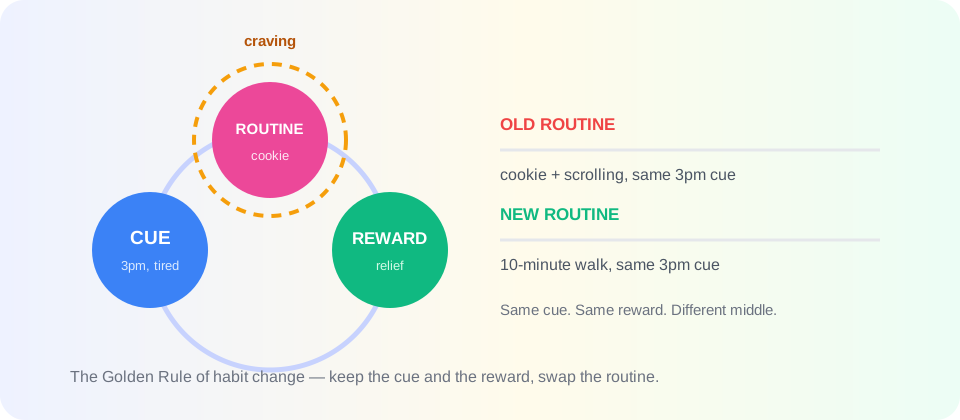
The Power of Habit visual — the habit loop: cue, routine, reward with a craving

Most of your day runs on autopilot

Duhigg's central claim: a huge share of what we do each day is not a decision — it is a habit. Cue fires, routine runs, reward lands. No thinking required.

That is why willpower alone rarely changes behavior. The way to change a habit is to understand its loop — and then rewire one part of it.

Small Wins Compound

Small wins are not small. Duhigg shows that one changed habit creates evidence you can change — and that evidence fuels the next change.

You can't delete a habit — you rewire it

Duhigg's Golden Rule: to change a habit, keep the cue and the reward, but insert a new routine. The loop still gets satisfied — the behavior changes.

Same Loop, New Routine

Old Routine
"3pm hits, I grab a cookie and scroll."
⬇️
New Routine
"3pm hits, I walk for 10 minutes."

The cue (3pm slump) and the reward (relief, a break) stay the same. Only the middle changes — which is why the loop survives the swap.

Which habit will you rewire?

Pick the habit you want to change:

Habit to rewire:

What new routine could give you the same reward as ?

The Habit Loop

Every habit runs the same three steps — and a craving is what makes it stick: cue, routine, reward.

👀

CUE

A trigger starts it

→
❤️

CRAVING

You want the relief

→
⚡

ROUTINE

You do the behavior

→
🎁

REWARD

You feel better

↺

🍪 Real-World Example: The 3pm Slump

1
CUE
It's 3pm, you're tired and staring at an inbox
2
CRAVING
"I need a break and some energy."
3
ROUTINE
Walk to the kitchen, grab a cookie, scroll the phone
4
REWARD
Sugar + distraction = relief, at least for 10 minutes
🔁 The brain learns: "3pm means cookie and scrolling." Soon the cue alone creates the craving.

4 steps to change any habit

Duhigg's practical method — work through these in order:

Step 1

🔍 Identify the routine

Name the exact behavior you want to change.

Example: "At 3pm I eat cookies at my desk."
Step 2

🧪 Experiment with rewards

Test alternatives to find what you actually crave.

Example: Walk instead of snack. Is the reward sugar, or just a break and someone to talk to?
Step 3

🎯 Isolate the cue

Log when the urge hits. Almost every cue falls into 5 buckets.

Location · Time · Emotional state · Other people · Preceding action
Step 4

📝 Have a plan

Write the if-then: when the cue appears, run the new routine.

Example: "When it hits 3pm, I walk 10 minutes with a colleague."

Keep the cue & reward. Swap the routine.

Same trigger, same payoff — different middle:

OLD ROUTINE (same cue)NEW ROUTINE (same reward)
🍪 3pm cookie + scroll🚶 10-minute walk outside
📱 Phone in bed at night📖 10 pages of a novel
📺 TV to unwind after work☕ Music + cooking something real
😬 Snack when stressed🌬️ 3 minutes of slow breathing, then decide
💳 Buy when bored📝 Add it to a 24-hour wish list

Meet Lisa

Meet Lisa

Lisa is the story Duhigg opens the book with. Smoking, drinking, debt, no job:

"I was a walking ball of bad habits."

Her doctor hands her one assignment: change one habit — cigarettes — and map its loop.

She discovers the cue is stress, and the real reward isn't nicotine — it's relief and a 5-minute social break:

Step 1 — Same cue, new routine: A stressful moment used to mean a cigarette. She replaces it with a short walk and a chat.
Step 2 — The cascade: The walk becomes jogging. Jogging changes her sleep and mood. She starts planning meals and a budget.
Step 3 — Keystone habit: One habit pulls the others along. Two years later: no cigarettes, no alcohol, back in school, debt under control.

💡 The Lesson

You don't need to fix everything at once. Change one keystone habit and the rest often follow — because the new habit gives you evidence that change is possible.

🧠 Test your habit instincts

Three scenarios from the book. Pick the answer that follows the loop.

Question 1

You want to stop snacking every afternoon. What does Duhigg say to do first?

Question 2

You swapped your nightly TV for a walk, but you keep going back to TV. What is the likely reason?

Question 3

Which of these is a keystone habit — one that cascades into other areas of life?

Quiz Complete!

🛠️ Design Your Rewire Plan

Don't just understand the loop. Write your if-then for tomorrow.

✅ Your Rewire Plan

Some habits pull all the others

A keystone habit triggers a chain reaction. Pick one and let it spread.

🏃
EXERCISE
Move Daily
→ Better eating, sleep and mood
🍽️
FOOD JOURNAL
Track What You Eat
→ Awareness changes choices
🛏️
MAKE THE BED
One Small Win
→ Starts a chain of order
💸
TRACK SPENDING
Write It Down
→ Spending tends to drop on its own

Keystone habits work because they create small wins — and small wins are the evidence that bigger change is possible.

The Visual Book Map

One visual containing the entire book's structure.

THE POWER OF HABIT
HABIT LOOP
▼
CUE
The trigger
REWARD
The payoff
▼
GOLDEN RULE
▼
👀 CUE
❤️ CRAVING
⚡ ROUTINE
🎁 REWARD
▼
🔍 Identify the routine
🧪 Experiment with rewards
🎯 Isolate the cue
📝 Have a plan
🙈 "Just use willpower"
🚫 Trying to delete the habit
❓ Never finding the cue
🌀 No replacement routine
▼
SAME CUE + SAME REWARD + NEW ROUTINE
▼
KEYSTONE CHANGE

One rewired habit creates small wins — and small wins cascade into the rest of your life.

THE POWER OF HABIT IN 60 SECONDS

Habits run on a loop: cue, routine, reward.
A craving is what makes the loop stick.
You can't delete a habit — you rewire it.
Keep the cue and reward. Change the routine.
Find your keystone habit and let the rest cascade.
Change sticks when you believe it's possible — often with a community behind you.

🧠 "What cue always leads to my worst habit — and what else could I do in that exact moment?"

What will you rewire first?

Choose your path:

🧠

UNDERSTAND

I want to learn more

🔁

APPLY

I want to rewire a habit

📖

READ

I want to read the full book

This is an independent educational summary and visual interpretation of the book. For the complete work, see the original book by Charles Duhigg.

Prefer reading? See the full 10-minute text summary →