BestGlobalOffers Visual Book Lab

ATOMIC HABITS

How tiny changes can transform the way you live

by James Clear · A visual and interactive guide

Instead of just reading a summary, experience the ideas. This visual journey takes you through the core framework of Atomic Habits — from identity shifts to the habit loop, with interactive elements you can actually use.

Explore the Experience →
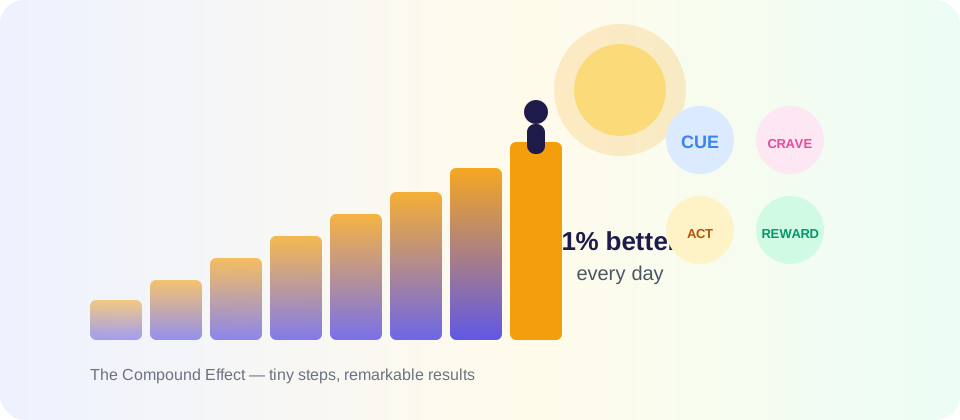
Atomic Habits visual — staircase of 1% improvements and the habit loop: cue, crave, act, reward

Small changes, remarkable results

What if changing your life didn't require one enormous decision? What if the real transformation came from the small things you repeatedly do?

James Clear's Atomic Habits explores a simple idea: meaningful behavioral change can emerge from small improvements repeated consistently.

The Compound Effect

Each small step compounds. Over hundreds of days, tiny differences become remarkable results.

Don't just chase the result

Most people try to change their lives by focusing on the outcome. Clear's approach shifts the focus toward systems and identity.

Goals vs Identity

Outcome
"I want to lose 10 kilos."
⬇️
Identity
"I am becoming a healthy person."

Every time you perform a behavior, you create another piece of evidence about the kind of person you are becoming.

Choose your identity

Select an identity you're interested in developing:

Your identity:

What's one tiny action a would take today?

The Habit Machine

Clear describes four stages of habit formation: cue, craving, response, and reward.

👀

CUE

Something triggers you

→
❤️

CRAVING

You want something

→
⚡

RESPONSE

You act

→
🎁

REWARD

Your brain learns

↺

📱 Real-World Example: Checking Your Phone

1
CUE
Your phone vibrates
2
CRAVING
"Maybe someone messaged me."
3
RESPONSE
You pick up the phone
4
REWARD
New information / social interaction
🔁 Your brain learns: "Checking my phone feels rewarding." → The loop repeats.

How to build a good habit

Clear presents these four principles as the framework for creating good habits.

Law 1

👁️ Make It Obvious

Make the cue visible and accessible.

Example: Want to read more? Place your book on your pillow.
Law 2

❤️ Make It Attractive

Connect the habit with something you enjoy.

Example: Only listen to your favorite podcast while walking.
Law 3

⚡ Make It Easy

Reduce the effort required to begin.

Example: Instead of "I'll exercise for 90 minutes," start with "I'll put on my running shoes."
Law 4

🎁 Make It Satisfying

Create an immediate sense of progress or reward.

Example: Mark your reading session on a simple tracker to see progress.

How to break a bad habit

To weaken an unwanted habit, reverse the process:

BUILD A GOOD HABITBREAK A BAD HABIT
👁️ Make it obvious🫥 Make it invisible
❤️ Make it attractive🚫 Make it unattractive
⚡ Make it easy🧱 Make it difficult
🎁 Make it satisfying😐 Make it unsatisfying

Meet Alex

Meet Alex

Alex wants to read more books. Every January, Alex says:

"This year I'm going to read 30 books."

By February, the book sits untouched on a shelf.

Instead of trying to become a "30-books-a-year person," Alex changes the environment:

Step 1 — Make it obvious: The book goes beside the bed.
Step 2 — Make it easy: Alex commits to just two pages.
Step 3 — Make it satisfying: Every reading session gets marked on a simple tracker.

💡 The Lesson

Don't make the habit heroic. Make the habit repeatable.

🧠 What would you do?

Test whether you actually understood the framework. Answer the questions below.

Question 1

You want to start exercising. Which approach best reflects the framework?

Question 2

You want to stop checking social media every five minutes. What is the most direct application of the framework?

Question 3

You want to build a meditation habit but keep failing. According to the Four Laws, what should you do first?

Quiz Complete!

🛠️ Build Your Habit

Don't just understand the book. Do something with it.

✅ Your Habit Statement

Don't start with the finished habit

Start with the gateway version.

⬇️
READING
Read a Book
→ Read 2 Pages
⬇️
RUNNING
Run 5 km
→ Put on Running Shoes
⬇️
WRITING
Write an Article
→ Write One Sentence
⬇️
MEDITATING
Meditate 30 Min
→ Sit Down for 2 Minutes

The point isn't that two minutes magically solves everything. The point is to make starting easy enough that the behavior can become repeatable.

The Visual Book Map

One visual containing the entire book's structure.

ATOMIC HABITS
ATOMIC HABITS
▼
IDENTITY
Who do I want to become?
SYSTEMS
What do I repeatedly do?
▼
HABIT LOOP
▼
👀 CUE
❤️ CRAVING
⚡ RESPONSE
🎁 REWARD
▼
👁️ Obvious
❤️ Attractive
⚡ Easy
🎁 Satisfying
🫥 Invisible
🚫 Unattractive
🧱 Difficult
😐 Unsatisfying
▼
SMALL WINS → REPETITION → NEW IDENTITY
▼
BETTER RESULTS

Big changes don't begin with big actions. They begin with small behaviors repeated consistently.

ATOMIC HABITS IN 60 SECONDS

Big changes don't always begin with big actions.
They can begin with small behaviors repeated consistently.
Instead of focusing on the result you want, think about the person you want to become.
Then build a system that makes the desired behavior easier to repeat.
Make it obvious, attractive, easy, and satisfying.
To weaken a bad habit, reverse the process.

🧠 "What would a person who already has the identity I want behave like today?"

What will you do today?

Choose your path:

🧠

UNDERSTAND

I want to learn more

🎯

APPLY

I want to create a habit

📖

READ

I want to read the full book

This is an independent educational summary and visual interpretation of the book. For the complete work, see the original book by James Clear.

Prefer reading? See the full 10-minute text summary →